Kufer, K., Schmitter, C.V., Kircher, T. & Straube, B. (accepted). Temporal recalibration in response to delayed visual feedback of active versus passive actions: An fMRI study. Scientific Reports. IF = 4.6 PrePrint
The three main findings are:
- Both active and passive conditions experienced visual recalibration effects, but an “active advantage” was observed specifically in visual conditions, demonstrating the sensorimotor contributions to temporal recalibration.
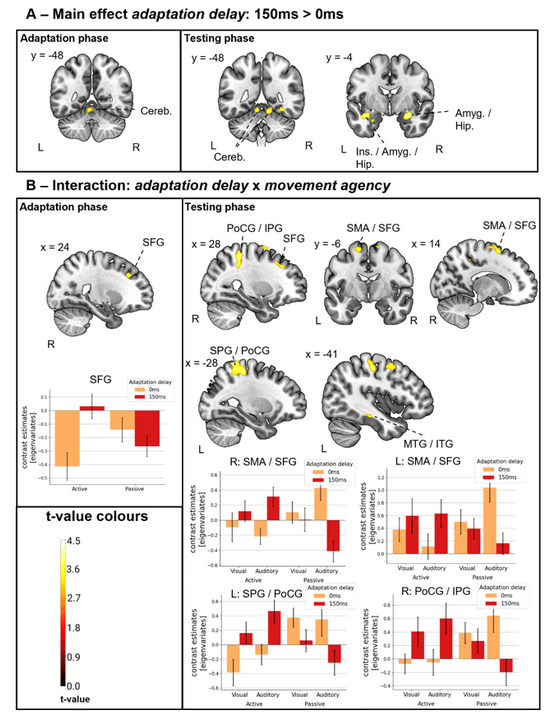
- Recalibration effects, associated with left cerebellum activation, were generally observed, while action-related activation (active > passive) occurred in the right middle/superior frontal gyrus during adaptation and test phases.
- The transfer of recalibration from visual to auditory stimuli was linked to action-specific activations in the cingulate cortex, angular gyrus, and left inferior frontal gyrus, highlighting the inter-sensory contributions and the complex nature of sensorimotor integration in temporal recalibration.
Abstract:
The brain can adapt its expectations about the relative timing of actions and their sensory outcomes in a process known as temporal recalibration. This might occur as the recalibration of timing between the outcome and (1) the motor act (sensorimotor) or (2) tactile/proprioceptive information (inter-sensory). This fMRI recalibration study investigated sensorimotor contributions to temporal recalibration by comparing active and passive conditions. Subjects were repeatedly exposed to delayed (150ms) or undelayed visual stimuli, triggered by active or passive button presses. Recalibration effects were tested in delay detection tasks, including visual and auditory outcomes. We showed that both modalities were affected by visual recalibration. However, an active advantage was observed only in visual conditions. Recalibration was generally associated with the left cerebellum (lobules IV, V and vermis) while action related activation (active > passive) occurred in the right middle/superior frontal gyrus during adaptation and test phases. Recalibration transferred from vision to audition was related to action specific activations in the cingulate cortex, the angular gyrus and left inferior frontal gyrus. Our data provide new insights in sensorimotor contributions to temporal recalibration via the superior frontal gyrus and inter-sensory contributions mediated by the cerebellum.
Link to preprint: https://doi.org/10.21203/rs.3.rs-3493865/v1
 Translational Neuroimaging Marburg